Alluvium Coffee Company

Amber Dream

Amber Dream

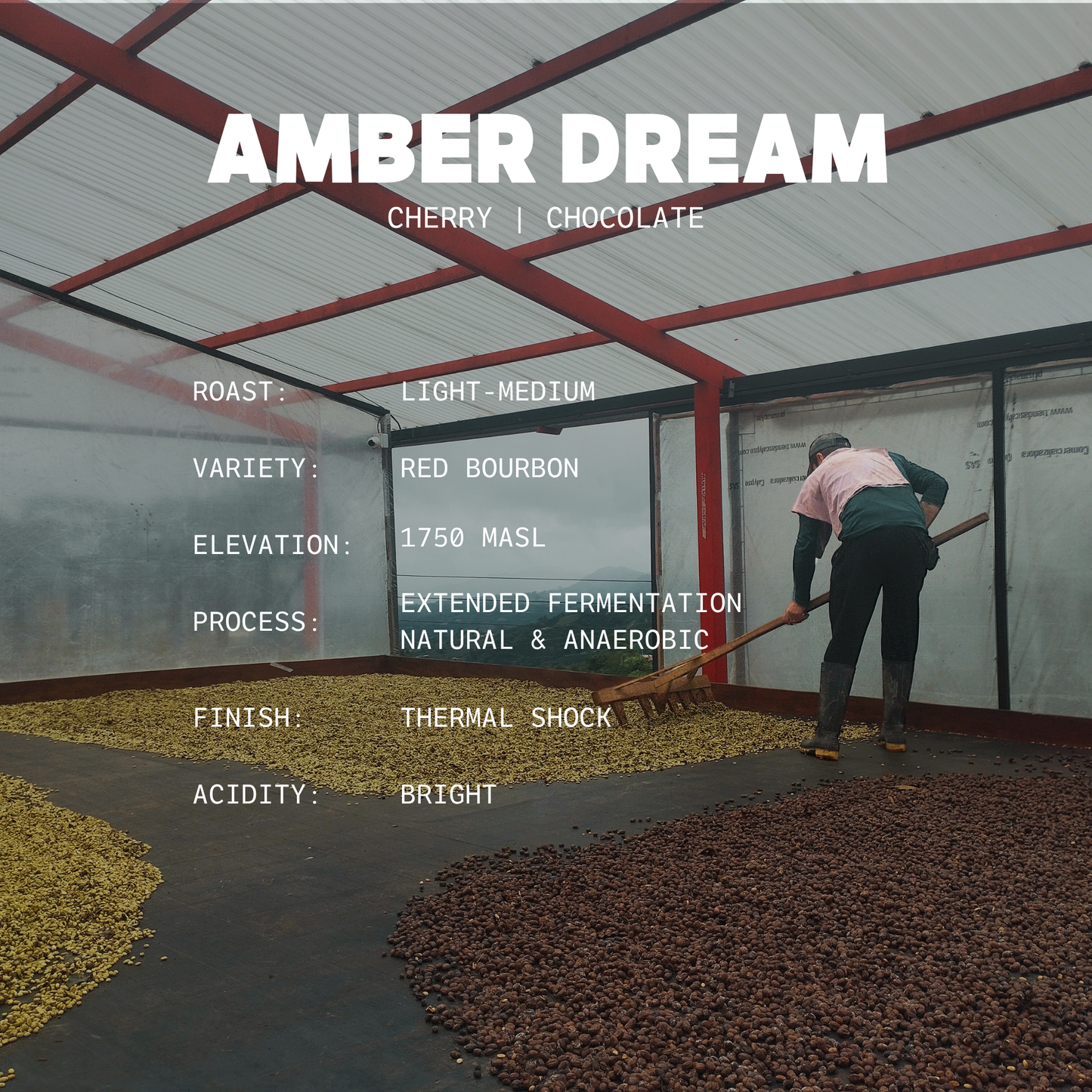
At Finca Las Flores, ripe Red Bourbon cherries are selectively picked, oxidized, and then undergo an extended anaerobic (oxygen-free) fermentation before the thermal shock and drying process. These complex steps produce a coffee with cherry, chocolate and caramel tasting notes.

Weight
Quantity
Regular price $16.00 CAD
Regular price Sale price $16.00 CAD
Sale Sold out
View full details
text-block-image-template--19494213156909__ss_text_block_pro_T4abJG

Finca Las Flores

Finca Las Flores, located 1,700 MASL in Huila, Colombia, was founded in 1990 by Edilberto Vergara and Nubia Ayure. They began the farm with approximately 18,000 coffee trees and have grown it into an estate that now produces over 100,000 kg of coffee each year. Under the leadership of Ediberto and his sons, Johan and Diego, the farm cultivates many different varieties and uses diverse processing methods, making their coffees highly sought after around the world.

text-block-image-template--19494213156909__ss_text_block_pro_B4qPBH

Finca Las Flores

Extended Fermentation

At Finca Las Flores, coffee cherries undergo a series of oxidation and fermentation stages, followed by thermal shock and a controlled drying process. First, ripe cherries are harvested and allowed to rest and oxidise for 18 hours, a step that helps them reach optimal ripeness. The cherries then undergo a 28-hour anaerobic (oxygen-free) fermentation, during which the temperature rises to a maximum of 42°C. After this stage, the cherries are transferred to 50kg bags and held at 16–20°C for an additional 30 hours. Finally, they are fermented for 18 hours in water at 45°C, marking the end of the anaerobic fermentation process.

text-block-image-template--19494213156909__ss_text_block_pro_gM8eT7

Arabica

Bourbon

It is a tall variety characterized by relatively low production, susceptibility to the major diseases, and excellent cup quality. French missionaries introduced Bourbon from Yemen to Bourbon Island (now La Réunion)—giving it the name it has today—in the early 1700s. Until the mid-19th century, Bourbon did not leave the island. But beginning in the mid-1800s, the variety spread to new parts of the world as the missionaries moved to establish footholds in Africa and the Americas. Today in Latin America, Bourbon itself has largely been replaced by varieties that descend from it (notably including Caturra, Catuai, and Mundo Novo), although Bourbon itself it is still cultivated in El Salvador, Guatemala, Honduras, and Peru.